STRIFE Competition Infrastructure
The
Crucible
A six-sided cage built for one purpose: to produce a definitive result. Not a ring. Not a cage. Both — and designed around the reality that modern combat does not fit inside four corners.
“Every STRIFE event takes place inside The Crucible. There is no escape from the result — only the question of how you got there and what it cost you.”
— STRIFE Competition Standards
Structure Specifications
Structure
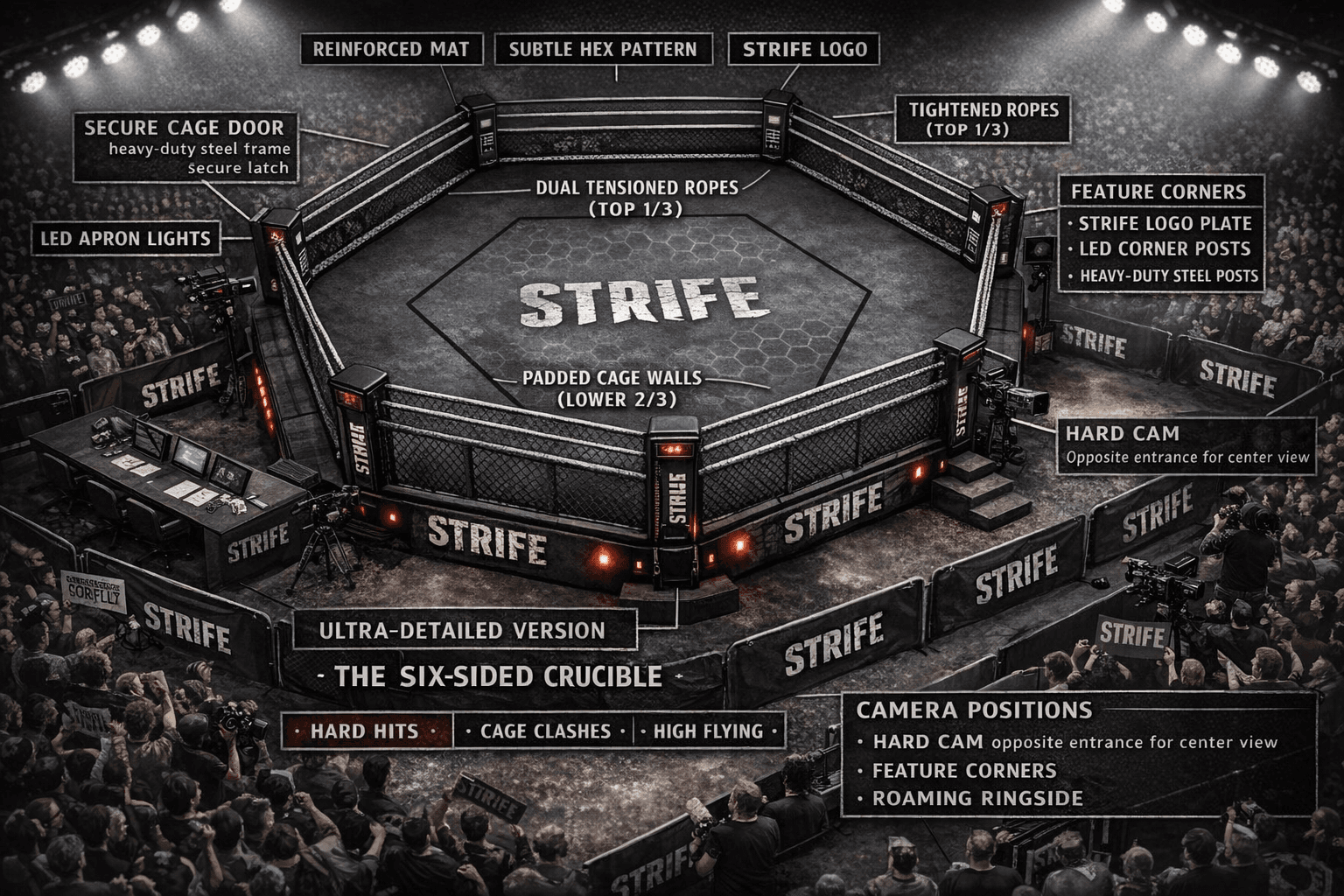
Six-sided hexagonal cage
Upper Third
Dual tensioned rope system
Lower Two-Thirds
Reinforced padded cage walls
Mat Surface
Reinforced canvas with recessed hex pattern
Entry
Heavy-duty steel frame cage door with secure latch
Apron
LED-lit apron perimeter
Corner Posts
Heavy-duty steel with LED inserts and STRIFE logo plates
Primary Camera
Hard cam, opposite entrance, full center view
Design Rationale
Cage Architecture
The lower two-thirds of each panel is constructed from padded cage wall — impact-rated, with enough give to absorb a body but enough resistance to end a career if you hit it wrong. The upper third opens to dual tensioned ropes, preserving the aerial dimension of wrestling while keeping the structure inescapable.
The Hex Format
Six sides means six corners. Every corner in The Crucible is a feature corner: STRIFE logo-plated, LED-lit, built from heavy-duty steel posts. More corners means more geometry — more angles of attack, more places to trap an opponent, more ways to get hurt. The ring does not reward the same tactics as a traditional four-sided square.
LED Apron System
The apron perimeter runs a full LED array calibrated to the broadcast color grade — STRIFE orange at baseline, shifting to deep red during high-leverage moments at the discretion of the production team. In a darkened arena, the structure glows from the floor up.
The Door
There is one entry and exit point. The cage door is heavy-duty steel frame with a secure latching mechanism. It can be opened. It can be locked. Whether it is and by whom is at the discretion of the booking — but the door is always there, always an option, always a temptation.
Mat Construction
The canvas is reinforced beyond standard wrestling specification to accommodate the hybrid combat style of STRIFE competition. The subtle hex pattern pressed into the surface is functional as well as aesthetic — it increases traction for grappling exchanges at speed.
Camera Infrastructure
The hard cam sits directly opposite the entrance, giving a dead-center view of the full structure for every broadcast. Secondary positions at the feature corners capture close-range exchanges. Roaming ringside cameras work the apron and cage wall moments. The Crucible was designed as much for the viewer as for the competitor.
Built for the Full Spectrum
The Crucible was engineered to accommodate the three pillars of STRIFE competition without compromising any of them. Hard hits land harder against padded cage walls than canvas. Cage surfaces create collision opportunities that a standard ring cannot. The rope system preserves the aerial game in full.
Hard Hits
The cage wall converts momentum into damage. A brawler who backs an opponent into the structure operates at maximum efficiency.
Cage Clashes
Six panels, six corners, one door — each a weapon. The structure itself is part of every match.
High Flying
Dual tensioned ropes and cage walls create a vertical game unlike any standard ring. The geometry rewards creativity.
Broadcast Infrastructure
The Crucible was built with production in mind from the ground up. The hard cam position — directly opposite the entrance — provides the primary broadcast angle: a clean, unobstructed view of the full structure, the entrance, and the ring interior simultaneously.
Feature corner cameras sit at alternating corners of the hexagon, capturing lateral exchanges and cage wall contact at close range. Roaming ringside operators cover the apron and door area. No matter where in the structure the action goes, it is on camera.